A recent graduate of the UW School of Public Health’s Community-Oriented Public Health Practice program spent a year building trust with rural gun owners. What she found upends a common assumption about who’s willing to listen.
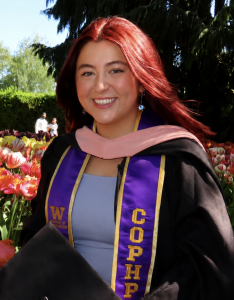
When Madison Leon pitched a project to interview rural Washington gun owners about how they store their firearms, she expected to spend a lot of time earning trust as an outsider — a self-described “city kid” from Tacoma, by way of four years in Boise, walking into communities she didn’t grow up in to talk about a subject as personal as guns in the home.
What she found instead surprised her: doors opened almost immediately.
“They were so, so sweet,” she said of the rural partners, community members, and even an NRA representative who sat in on one of her focus groups. “I didn’t have any negative experiences with any people I talked to.”
From a Practicum to a Statewide Toolkit
Leon’s work is the product of back-to-back practicum and capstone placements with Public Health – Seattle & King County’s Lock It Up program, which has promoted safe firearm storage in Washington since the late 1990s under a simple message: a locked gun is a safe, secure, and ready gun. The program distributes storage devices and works with partners across the state to reduce unintentional shootings, firearm theft that leads to violence, and suicide.
Leon came to the work with a long-standing interest in firearm injury prevention that she hadn’t been able to pursue as an undergraduate. “There was not a lot of funding,” she said of that earlier chapter, “so I was pretty disappointed.” When the practicum opening came up through UW’s Community-Oriented Public Health Practice (COPHP) MPH program, she jumped on it.
Her practicum work — an evaluation of the Lock It Up program’s history, partner interviews, and legislative talking points — led her supervisor, Karyn Brownson, Community Safety Manager in Public Health – Seattle & King County’s Violence and Injury Prevention Unit, to pitch her a capstone: design and test new safe-storage messaging specifically for rural Washington communities, where gun ownership rates are higher and public health messengers are often viewed with more skepticism.
For Leon, whose undergraduate emphasis was in health education and promotion, it was close to a dream assignment. “I love looking at behavior theories and how people’s brains work,” she said, “and what’s going to convince someone to change their behavior.”
Brownson remembers Leon arriving with a clear ask. She’d previously tried to break into gun safety work through an internship elsewhere and came away frustrated by how little substantive work she was given. “She basically said, give me meaningful responsibilities, give me a challenge,” Brownson said. “She was very interested in and dedicated to the issue and also a really strong learner. She didn’t have a lot of lived experience or work experience in the gun safety world but threw herself into learning and building expertise in these particular issues.”
That preparation showed. “She knew our work, she knew the program, and had done research on firearm issues,” Brownson said, “so Madison was incredibly well prepared and supported through COPHP, through her professors, and her normal coursework as well.”
Over the course of the project, she interviewed program partners across rural counties, built her own prototype safe-storage messages, and ran focus groups to test them — a first for her. She’s now translating the findings into a toolkit that Lock It Up staff and partners can use going forward.
Rethinking the Urban-Rural Divide
Much of what makes Leon’s work notable isn’t just the messaging she developed — it’s what her process revealed about a persistent assumption in public health: that rural communities will be resistant to firearm safety outreach.
“It definitely was very different than what I think a lot of perceptions from people in bigger cities have,” she said. Going in, she was candid with the people she interviewed about who she was and where she came from. Rather than leading with her own opinions, she tried to listen. “I tried to go into it with curiosity,” she said, “and not tell people my opinions… because that’s not the point of this project.”
That approach, paired with warm introductions from trusted local partners and one-on-one video calls before every interview, opened doors she hadn’t expected. Even a get-to-know-you Zoom call ahead of a formal interview, she found, made a measurable difference in how much people were willing to share.
Her biggest takeaway speaks to something public health communicators everywhere are grappling with: mistrust of government and institutional health messaging runs deep, but it isn’t insurmountable if the right messenger is already embedded in the community.
“If you can find a messenger that’s already trusted and embedded in that community,” she said, “that’s your golden ticket.”
Brownson saw the same dynamic play out from the supervisor’s chair. “She’s been humble and curious, which I think is important when you’re working with a community you don’t come from,” Brownson said. “That combination of humility and curiosity has allowed her to build relationships with people across some pretty deep lines of difference.” The response from community partners, she added, has been positive across the board — and it wasn’t just her own read. After Leon’s presentation at the Safe States Alliance conference, other attendees sought Brownson out directly. “People reached out to me after that conference to say, your intern is amazing. Where did you get this person?”
From Capstone to Career
The project has already carried Leon well beyond the classroom. She presented her findings at the Safe States Alliance national conference — her first national presentation — where she connected with public health practitioners working to build trust in rural communities across a range of issues beyond firearm safety. She also presented to Washington’s Center for Firearm Injury Prevention, an experience she described as surreal: “There were a bunch of big names in there that I had seen doing all my research and papers, and I was like, oh my gosh, I used your guys’ work.”
That presentation led directly to introductions with researchers holding new grant funding who may be looking to grow their teams — the kind of “warm handoff” Leon relied on throughout her own fieldwork, now working in her favor.
She’s also preparing her findings for peer-reviewed publication, likely as two separate papers, alongside her faculty advisor, Erin Morgan.
That Leon has been able to stay connected to the Lock It Up team past graduation isn’t the norm, Morgan noted. “I think she got really lucky in that it was such a good fit, and especially to be able to continue to work with them after graduation. It’s always very nice when that works out,” Morgan said, “but with public health funding being what it is right now, it was kind of a combination of that she is very talented and very good at the work that she does, brings a really good perspective, and that the stars kind of aligned with the funding to make that come through.”
For Leon, who is currently job-hunting in a tight market, the recognition has been a turning point. “I don’t have a job right now, but I’m feeling optimistic,” she said. “I didn’t realize how crucial this capstone would be in my job search… I guess sometimes I still see myself as just like a kid. And then I’m like, oh wait — I did do all this work, and I can contribute to society, to this field that I care so much about.”
Why COPHP
Morgan, who advises COPHP MPH students through their capstones, says flexibility is by design — and it’s a big part of what prepares graduates for the workforce. Students have gone on to build communication tools for Public Health – Seattle & King County, partner with the Iraqi Community Center on a program evaluation and take on dozens of other projects shaped around their own interests and a community partner’s real needs. “Because they have that flexibility and can work with a potential employer and kind of show off their skills before they start, I think that’s really helpful,” Morgan said. Just as important, she added, is the arc of the work itself: students carry a project from an idea through a literature review, a plan, execution, a written report, and an oral presentation to both the program and their community partner. “They’re checking a lot of those boxes in terms of what are skills that you’re going to need when you get to the workforce.”
On the Lock It Up side, Leon is far from the first COPHP student Brownson’s team has hosted. “We have taken practicum students pretty much every year since I started here, and some people stay for their capstone,” she said. “We’ve had some real superstar students placed with us, and we have found their projects incredibly useful for our programming and our work.”
Leon chose the COPHP program specifically because of its structure: problem-based learning built around real-world practicum and capstone placements with community and government partners, rather than a traditional thesis track.
“I was so burnt out of lectures and textbooks,” she said of finishing her undergraduate degree straight through. “The problem-based learning… made me work a different side of my brain. I’m a very visual, hands-on learner, and this program really supported that.”
She credits several faculty members with shaping her experience, from Barbara Obena, who taught her first course in the program and helped ease the nerves of a brand-new graduate student, to Miruna Buta, whose small evaluation class and a shared road trip to a site visit built a lasting mentorship. She also pointed to Erin Morgan’s quantitative methods course and a final course with Mohit Nair, whose background spanning government, nonprofit, and industry (he now works at Microsoft) gave her a window into where the field of public health is headed.
What stayed with her most, though, was the infrastructure behind the practicum and capstone placements themselves. “Having practicums well-packed and ready to go for students was so helpful,” she said. “Knowing that there were people who trusted this program and the students they chose was huge for me… it was a great way to start my professional public health journey with that level of trust from real public health entities.”