Anjulie Ganti works to place communities at the center of public health and teaches students how to do the same.
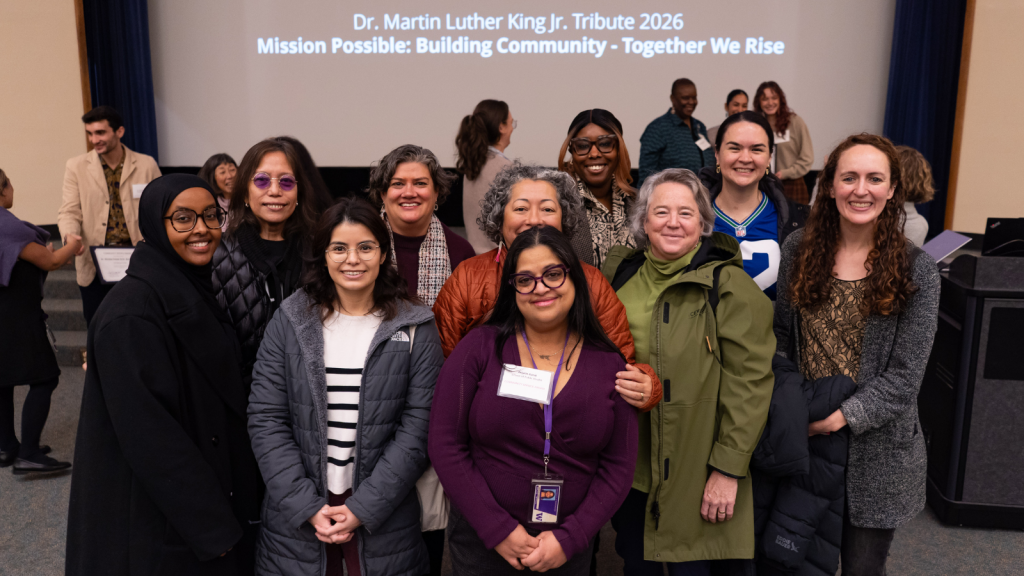
Anjulie Ganti, teaching professor in the Department of Health Systems and Population Health and Associate Director of the Public Health—Global Health major, recently received a 2026 Community Service Award. The award is part of the annual Dr. Martin Luther King Jr. Tribute which recognizes members of the UW Health Sciences schools and UW Medicine who reflect Dr. King’s principles of service, justice and equity.
Since 2018, Ganti has overseen 300+ students per year and their experiential learning for the Public Health—Global Health major. Within the major, Service Learning courses work as an entry point into the world of public health. “I partner with community organizations to create projects for each section of students,” said Ganti. “By the end of the course, I want students to have a deeper sense of their humanity, cultural humility and proper equity-based theories for how to do their public health practice.”
Service Learning
The Service Learning course is required for all students in the major. Ganti teaches the full-class lecture, after which students are divided into sections of 20-30. Each section is paired with a community partner and completes a project in collaboration with that partner The instructional team develops bespoke curricula for each section, tailored to the partner’s population and target issue, and teaches toward those goals.
The goal is for the course to be culturally relevant and responsive to the projects so students can apply the theories they learn about in the classroom and create a practical product for their community partner. “If we have students from the communities we’re working with, we really encourage them to join the project that serves those communities,” said Ganti. “And for students who aren’t from those communities, we want them to get in there and work with their peers so they can cultivate more empathy and increase exposure. The goal is not to say they know the community, but that they are familiar.”
Over the course of the class, students have worked with community partners including Radio KDNA, Vulnerable Populations Strategic Initiative, UW Disability Advocacy Project, and the Latinx Health Board. Previous project deliverables have included health promotion videos, podcasts or social media posts, or workshops and after school programs which students facilitate.
For one project, students partnered with Indian American Community Services to explore how oral histories from elders can help improve health and wellness. Students learned how to gather oral histories, analyze transcripts, and identify important themes. While working on their interviews in the field, students learned about theories applicable to their work, such as Life Course Perspective, cultural humility, and cultural wealth frameworks. “I want my students to have an ‘Aha! moment,’ a talk in class or discussion with an interviewee that changes their perspective on their life or the work,” said Ganti. “A course goal is for students to recognize who they are, have a positive identity for themselves and to see how they can contribute. For students who feel they may not have that, it’s about showing them that they’re a part of this work too. We need everyone!”
Finding The Why
Ganti encourages her students and all public health students to get serious about their reason for doing this type of work. “I know, ‘what’s your why’ has become cheesy, but it’s so important,” said Ganti. “To do this work you have to be here because there’s someone or something that you care about. You’ve got to have something that has radicalized you to be in service.”
Ganti’s why: the people and communities she doesn’t know are at the center of her public health work. “Our school is subsidized by public dollars because the public is entrusting us to produce the best public health professionals we can,” said Ganti. “I am teaching with people’s loved ones in mind. I teach to that, the people I may never know, but whose lives will be shaped by students. That’s what inspires me.”
Ganti’s efforts to teach students how to center communities and their voices in public health embody the principles of service, justice, and equity at the heart of Dr. King’s legacy. She hopes that students will continue to do the same.