UW Health Systems and Population Health researchers published a first-of-its-kind study evaluating the experiences of Hanford cleanup workers’ during and after exposure to toxic chemical vapors.
Credit: Hanford Challenge.
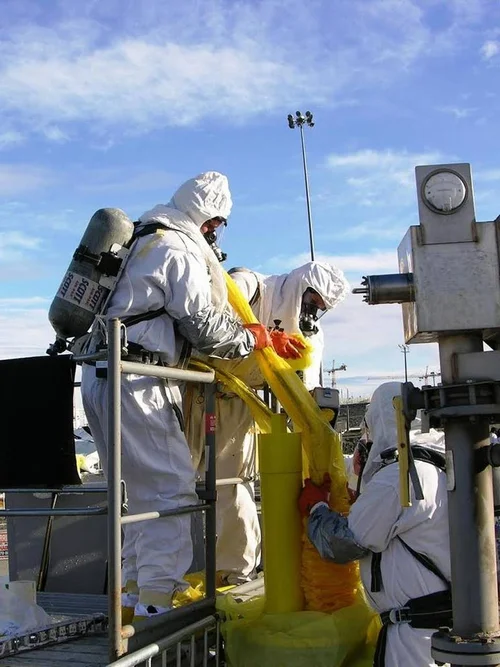
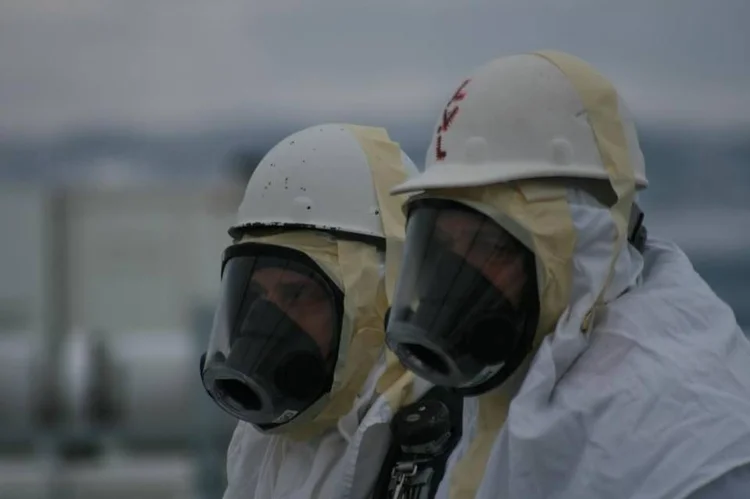
A gym locker room odor, followed by a lingering metallic taste in the mouth. These are often the first warning signs workers at the Hanford Nuclear Site sense when they’ve been exposed to toxic chemical vapors. Later, they commonly report difficulty breathing, nosebleeds, heart palpitations, headaches, dizziness, and burning eyes. For some, acute conditions evolve into life-altering chronic diseases like COPD, various cancers, asthma, cognitive decline, and early death. What happens to workers who put their lives on the line when they are forced to navigate illness, hostile work environments, and a labyrinth of paperwork and denied claims?
University of Washington researchers interviewed Hanford Nuclear Site cleanup workers to examine how they endure a workplace culture and healthcare system that routinely dismissed safety concerns and suppressed incident reporting, presumably to avoid payouts.
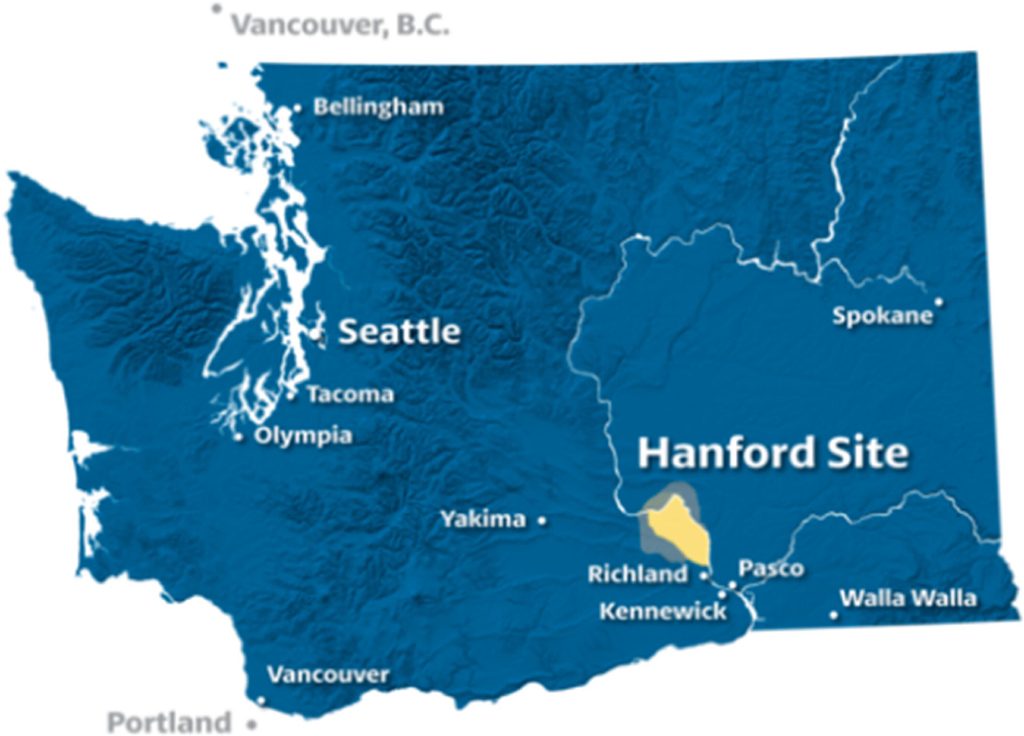
The Hanford Nuclear site
Credit: Hanford Challenge
Situated in the southeastern desert region of Washington State, the Hanford Site spans 586 square miles. As one of three main facilities established for the Manhattan Project, it produced plutonium for atomic weapons, including the first atomic bomb used in the Trinity nuclear test and the “Fat Man” bomb dropped by the United States on Nagasaki, Japan in 1945.
Hanford continued to manufacture plutonium for the U.S. nuclear arsenal until it was decommissioned at the end of the Cold War. Before production ended though, inadequate safety and waste disposal practices led to significant amounts of toxic and radioactive materials being released into the air, soil, groundwater, and Columbia River.
Shortly after, the U.S. Department of Energy, Environmental Protection Agency, and the Washington State Department of Ecology initiated what would become one of the most complicated and longest running environmental remediation efforts in the world. Now nearing its fourth decade, the cleanup project is currently estimated to last until at least 2069.
Credit: WA Department of Ecology
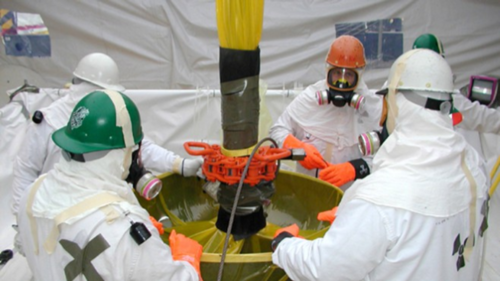
The site currently houses 177 underground tanks, well past their intended lifespan. They hold 56 million gallons of waste, including 1,500 volatile chemicals and organic compounds that accumulate as toxic vapors in the headspace of the tanks.
Over 8,000 people work at the Hanford Site’s cleanup effort, including those who manage, treat, and bury or dispose of tank waste. Since the cleanup project began, workers have been complaining about exposure to chemical vapors.
From 2009 to 2024, the DOE contracted Penser North America to manage Hanford workers’ compensation claims. Workers, labor unions, and legislators have criticized Penser and the DOE, citing high rates of claims rejections, arbitrary reasoning, delay tactics, and intimidation.
“This work is personal to me,” said Turk, “I lost my mom, and her two sisters, and many other cousins, to cancer associated with living downwind from Hanford and the Nevada Test Site.”
Like the Hanford cleanup workers, Turk belongs to the “nuclear frontline community.” The term represents populations who live or work near nuclear production, extraction, testing, storage, or cleanup sites. With the highest levels of exposure to radiation and related toxins, they face disproportionate negative health outcomes. Most commonly intersecting with some combination of identities of Indigenous, people of color, low-income, and rural, these communities have rarely received proper notification about exposure risks.
Turk also credits two UW courses for guiding her toward this research, starting with an anthropology class taught by Dr. Holly Barker that she took during undergrad. Later, in a COPHP MPH course, she analyzed Hanford through a problem-based learning case designed by Liz Mattson from Hanford Challenge, with UW Health Systems and Population Health faculty members Dr. Amy Hagopian, Aaron Katz, and Rep. Gerry Pollet.
What Hanford cleanup workers shared in 2016
Through extensive interviews with tank farm cleanup workers exposed to toxic vapor, Turk and coauthors produced five core themes around workplace safety, healthcare navigation, and barriers to compensation.
First, study participants reported that exposure often followed a predictable pattern of risk linked to temperature inversion. In this weather pattern, a layer of warm air sits over and traps a layer of cold air. When temperature inversion hits a farm tank, chemical vapors concentrate near the ground where crews are working. Though temperature inversions are forecastable, workers said that DOE kept sending them into the field and incidents continued occurring.
Credit: Hanford Challenge
According to participants, leaders viewed workers who raised safety concerns as slowing down the job.
In one story, management downplayed a mercury alarm going off by trying to convince workers that it wasn’t working properly. When the workers proved that it was working, the supervisors told them they “didn’t get that much” exposure. They also said “We’re going to average it over an eight-hour period. Don’t worry about it.” Another participant said that her employer blamed her body for being more sensitive than average to toxic chemicals.
Most participants described a culture where coworkers also pushed back and accused them of faking exposure symptoms.
They also reported that Hanford-contracted medical care was unsympathetic and conflicted.
Onsite doctors collected blood samples without revealing why and didn’t disclose results with the workers. One participant said it was like “twisting arms” to find out the purpose of the readings. He eventually developed blood cancer and toxic encephalopathy, a brain dysfunction caused by exposure to heavy metals and harmful substances. Once an engineer, his IQ percentile dropped from 87th to 27th.
Workers resorted to seeking unbiased care from independent providers, some driving hundreds of miles. Though not all doctors were willing to diagnose illnesses as being related to chemical exposures. The doctors who did submit medical records for L&I claims were often threatened with litigation by DOE attorneys within days.
In the fifth theme, participants said workers who did not “fight” the complex compensation system often stopped showing up to work or even died.
The first submission
After completing her capstone project and earning her MPH degree in 2016, Turk presented the findings at APHA. Not long after, she and coauthors submitted the original paper for publication.
“We knew we wanted to publish in New Solutions Journal due to their environmental and occupational health policy focus,” said Turk. Though the journal responded with a request for more work. With a baby on the way, Turk felt unable to take on another round of research. So, she proposed a new MPH project with Hanford Challenge, “And that’s when Lilly Deerwater grabbed the ‘baton.’”
The 2018 Hanford presumption law
Prior to the Hanford presumption law, to have their compensation claims approved, workers had to prove the chemicals they were exposed to at Hanford caused their illnesses. Lawmakers designed the presumption law to ease the burden of proof for sick employees. Longtime Hanford advocate and Heart of America Northwest co-founder, Rep. Pollet, co-sponsored the 2017 house bill that became the 2018 Hanford presumption law.
The goal was to make it easier to file for workers compensation and to appeal denied claims. After it took effect in June of 2018, when Hanford workers developed certain illnesses, workplace exposure became the presumed cause. Now, workers only have to prove they worked at Hanford in a covered role, for at least eight hours, and that they have one of the covered conditions.
Catching the baton
In 2021, for her MPH practicum project, Lilly Deerwater revisited the earlier research, evolving it into a longitudinal study. She assessed how the 2018 Hanford presumption law influenced the outcomes of the workers’ cases navigating care and compensation systems.
Unlike Turk, Deerwater does not come from a frontline nuclear community. She first learned about the decommissioned plutonium site’s ongoing effects on health as a COPHP MPH student, in the same course that Turk took many years prior. “It was a joy getting to work with Emily and the folks at Hanford Challenge, jumping into a project that meant so much to the people involved,” she said. “The Hanford workers we spoke with were so open about their experiences and excited about the work we were producing.”
“I was moved by the stories I heard and hope that by adding peer-reviewed qualitative research on the health outcomes experienced by workers, we can move towards making the health care and compensation processes better for workers in the future.”
– Lilly Deerwater, MPH
Despite the new legislation, workers continued to face systemic barriers as they sought specialized care and financial support. Deerwater’s longitudinal follow-up in 2021 revealed four core themes.
All participants were still experiencing exposure-related symptoms. With a new process to file state claims, those with previously denied claims could now refile. Though it was not always clear whether refiling claims would help. Participants still expressed confusing processes between state and federal claims, and a desire for more guidance navigating the system.
Credit: Hanford Challenge
Participants also still described a pervasiveculture ofdenial and secrecy from management. “While the workers are handling exposure-related symptoms, they and their families are expected to gather proof, file paperwork repeatedly, and follow up on paperwork that often mysteriously disappears.”
Many reported continued difficulties finding quality and unbiased health care. Presumably fearing litigation and being inundated with paperwork, local doctors continued torefuse to verify that workplace exposure caused their conditions. Workers even had trouble getting providers to put their diagnoses in writing.“I don’t know how to undo corruption that they’ve done with the clinics and doctors here,” said one participant.
They also reported continued gaps in safety protocols, and that management still failed to adequately inform workers of the risks. This included infrequent monitoring of only some chemicals, and that this monitoring happened at limited locations.
Still using the old claims system
In a 2019 paper, fellow UW SPH alumni found, “Penser is operating as if they are under the old system; for example, asking for 20-30 years of medical records. Penser also requests additional time to search for evidence to rebut the presumption claim… Penser has recently started refusing to provide financial assistance to workers who have already had their claims approved.”
This paper prompted the Voices of Hanford researchers to collect and incorporate new public claims data from the Department of Labor & Industries from 2014 to 2021. For instance, they learned that 16% of total claims were rejected before the 2018 law, and 19% of total claims were rejected after.
The first published qualitative study on Hanford workers’ experiences during and after chemical vapor exposure
With Deerwater’s added interviews and the new claims data, the article was much stronger. In 2025, the original research team came together to submit the longitudinal study, once again to New Solutions Journal. The paper was published in 2026, a decade after the project began.
Noting the small sample size, the coauthors say the data should be used to explore how rampant these problems are. To fix the system, participants proposed establishing independent medical clinics, expanding worker to worker peer support programs to navigate the claims process, and using proactive real-time chemical monitoring.
“It’s important to me that there is more peer-reviewed qualitative research published about the health effects experienced by the heroes who are cleaning up these nuclear sites.These men and women risk their lives each day to serve our country and keep us all safe. They deserve better medical care and compensation for their injuries. I’m proud to be publishing the first qualitative study about Hanford workers and their experiences.”
– Emily Turk, MPH
Coauthors of Voices of Hanford Workers Exposed to Chemical Vapors: Interactions with Workplace, Safety, Health Care and Compensation Systems:
Emily Turk – Clinical Instructor for UW Health Systems and Population Health, senior program analyst for Tacoma-Pierce County Health Department, COPHP MPH 2016 alumni
Lilly Deerwater – Economic and health policy advocate, COPHP MPH 2022 alumni
Liz Mattson – Senior program strategist for Hanford Challenge
Amy Hagopian – Professor emeritus for UW Health Systems and Population Health
Steven Gilbert – Founder and director of the Institute of Neurotoxicology and Neurological Disorders (INND), diplomat of the American Board of Toxicology, and affiliate professor in UW Environmental and Occupational Health Sciences
Dr. Gilbert passed away in 2025.The article includes a dedication to his memory, “for his mentorship and lifelong dedication to teaching his students and the public about toxicology and advocating for stronger public health policy.”
In October, Rep. Pollet told Washington State Standard the law has fallen short of his expectation and criticized the DOE for continuing to fight against compensating workers who fell ill after working at Hanford.