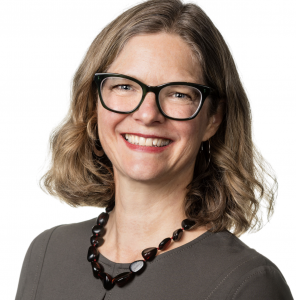
Dr. Blair Darney (HSERV PhD ’12) has been named editor-in-chief of Contraception, the journal of the Society of Family Planning and one of the most influential journals in reproductive health research. Her appointment reflects a career marked by international collaboration, policy-relevant scholarship, mentorship, and an enduring commitment to reproductive rights and autonomy.
Darney, a quantitative reproductive health services researcher and associate professor at Oregon Health & Science University (OHSU) School of Medicine, is known for her work on the organization, financing, and delivery of contraception, abortion, and maternal health services in the US and Mexico.
A career sparked by global experience
Darney traces her passion for reproductive health to her time as a Peace Corps volunteer in Senegal in the late 1990s. “I was first exposed to the reality and consequences of maternal morbidity and mortality,” she said. “And the reality and consequences of not being able to control one’s own fertility and how that fit in with human rights and autonomy for women overall.”
“I came with a lot of passion for my topic area. What the Health Services PhD program gave me were the quantitative skills to do the kind of research I wanted to do.”
After completing an MPH in global health, she initially imagined working in program implementation, but a position as a research associate at the OHSU School of Nursing changed her trajectory. “My boss was a researcher, and I really got excited about her work,” she said. “I thought, oh—well, the next step for that is a PhD.”
That decision brought her to the Health Services PhD program where her passion for reproductive health found a rigorous methodological home. “I came with a lot of passion for my topic area,” she said. “What the Health Services PhD program gave me were the quantitative skills to do the kind of research I wanted to do.”
Building a research portfolio across borders
During her time at UW, Darney completed two dissertation projects that foreshadowed the cross-national work she is known for today:
- A Washington State–focused project evaluating the implementation of miscarriage management services in family medicine residency programs
- An international project evaluating the impact of a conditional cash transfer program on adolescent fertility in Mexico
She recalls the strong mentorship that shaped her work, including support from faculty across the School of Public Health, School of Medicine, and IHME. These collaborations laid the foundation for her long-term partnership with the Instituto Nacional de Salud Publica/National Institute of Public Health in Mexico, where she was based from 2014-2017, and which later played a key role in her receiving the Fulbright García-Robles U.S. Scholar Award (2023-2024) to study abortion access in Mexico.
In her Fulbright project, she examined how federal policies around abortion access were being implemented in Mexico City and the surrounding region—work that continues to inform binational reproductive health policy conversations.
Committed to policy-relevant science
Darney’s research consistently centers on producing evidence that matters for real-world decisions. “I hope to make a contribution to generating evidence that can be used to advocate for policy,” she said. “Whether that’s clinical guidance – how health systems implement programs – or federal and state policy and laws.”
Working in contraception and abortion has always come with obstacles, she acknowledged. “There have always been challenges,” she said. “Right now, it’s even more challenging.”
She also works at the intersection of reproductive health and immigration, a space she describes as increasingly demanding. “Nothing is in isolation, as people’s lives aren’t,” she said. “Balancing responding to the world we have right now and building for the world we want to see—that’s a tension.”
Mentorship as motivation
Throughout her career, mentorship has been a central source of inspiration. “The most rewarding thing all along, in Mexico and in the U.S., is working with trainees,” she said. “They give me energy. They give me new ideas.”
She has mentored master’s and doctoral students who now serve in government, nonprofit organizations, and academia. “That really brings me a lot of joy,” she said.
Her own training at UW was shaped by influential faculty—including Dr. Emmanuela Gakidou at UW’s Institute for Health Metrics and Evaluation, Dr. Sarah Prager in Obstetrics & Gynecology, and Dr. Emily Williams, who was director of the Health Services PhD program while Darney was a student. “I’m thrilled follow her ongoing career at UW,” she added.
A path to editorial leadership—starting with peer review
Reflecting on her new role as editor-in-chief, Darney emphasized that editorial work is more accessible than many early-career researchers realize.
“It can seem like a real black box or a clubby world,” she said. “But if you are interested… the way to do that is do a lot of peer reviewing. And you can start when you’re a PhD student.”
She noted that doctoral students often make some of the most engaged reviewers. “They take it really seriously,” she said. “Some of my best reviewers are PhD students.”
Her own editorial path followed a straightforward progression, from peer reviewer to editorial board member (“a super reviewer,” she explained). She then became a deputy editor, where she made editorial decisions and is now editor-in-chief.
“At Contraception, the editorial board comes out of our peer review pool,” she said. “People who review a lot are then invited to join. And from there, we pick our deputy editors.”
What draws her to editorial work is its blend of big-picture vision and detail-oriented evaluation. “Being an editor is attention to both forest and trees,” she said. “I love being at the conceptual level—but I can get down into the details when I need to.”
Why PhD students should review manuscripts
Darney strongly encourages Health Services PhD students to start peer reviewing early in their careers. The benefits, she said, are substantial:
- Exposure to emerging work: “You see things people are working on that aren’t published yet.”
- Better writing skills: “It makes you a better writer… reading others’ work helps you see what’s clear and what isn’t.”
- Service to the field: “It’s a way to contribute to your community.”
- Professional opportunities: consistent, high-quality reviewers become known to journal editors.
Her advice for students is to begin with journals they already read and cite—and to ask mentors to recommend them as reviewers.
A reminder: there is no one “right” career path
Reflecting on her journey, Darney describes her career as anything but linear. “I’ve had a very zigzaggy path,” she said. “So it’s totally fine if you don’t know exactly what you want to do once you graduate.”
She encourages students not to view their PhD as a rigid path toward one specific career: “A PhD is a means to an end… there are lots of paths.”
Despite today’s difficult environment, she urges students to remain connected to their motivations. “When there’s a world on fire, how much energy do you spend reacting—and how much do you spend building for the world we want to see?” she reflected. “I don’t have the answer. But those are things I’m keeping in mind when things are hard.”