The UW Health Systems and Population Health Master of Public Health (HSPop MPH) program offers exceptional instruction in research methods, health care systems, health economics, health promotion, and the social determinants of health.
Housed in the CEPH accredited UW School of Public Health, this MPH program trains students to identify approaches, methods, and principles to improve the public’s health and the effectiveness of health care and population health services in the U.S. Our students learn how to address public health and population health issues and disparities, and understand the means by which social inequities, generated by power and privilege, undermine health.
U.S. News & World Report’s 2025 program and specialty rankings:
- #10 in public health graduate schools
- #12 in social and behavioral sciences programs
- #13 in health policy and management programs
Jump to a section
Degree Requirements
Courses and requirements listed on this page may be updated periodically to keep our curriculum relevant and beneficial to students.
The following requirements are effective as of Autumn 2026. Current students in the 2025-2026 academic year should reference Canvas for program requirements.
Core Courses and Requirements
Students earn a minimum of 63 credits to complete the Master of Public Health degree. This includes:
- 38 core courses credits (minimum); remaining credits can be elective coursework
- 25 graduate-level course credits (minimum)
- 4 practicum credits
- 9 thesis or capstone credits
All HSPop MPH students must complete the following courses and requirements. Waivers or substitutions for required core courses are rare and require pre-approval.
MPH Common Core Courses
As part of the University of Washington’s School of Public Health MPH Common Core, HSPop MPH students complete six interdisciplinary courses side-by-side with MPH students across all UW SPH departments.
These courses address foundational competencies required for the MPH degree, and enable our students to develop a common language and appreciation for the different disciplinary backgrounds and diverse perspectives of public health. Each course is taught by instructor duos from different UW SPH departments. They use student-centered learning strategies, with compelling case studies and engaging pedagogy.
Public Health Interdisciplinary (PHI) Required Courses:
Across the MPH Common Core curriculum, students focus on ethics and equity issues; global and local perspectives; communication, systems thinking, leadership and collaborative skills; and the evidence-to-action-and-back cycle.
PHI 511: Foundations of Public Health
3 credits
Option A:
PHI 513: Analytic Skills for Public Health II
3 credits
PHI 514: Determinants of Health
3 credits
PHI 515: Implementing Public Health Interventions
4 credits
PHI 516: Public Health Practice
3 credits
Program Seminar
HSPop MPH students are required to take two quarters of program seminar (offered autumn and spring).
Practicum
The practicum is a planned, supervised, and evaluated field-based experience (a minimum of 160-hour work) under the guidance of a site supervisor and a faculty adviser within a public health organization. The practicum provides students an opportunity to apply the disciplinary knowledge, methods, and values they learned in the MPH classroom to a professional, public or private public health environment such as nonprofit organizations, hospitals, local or state health departments, or for-profit firms.
Students complete the practicum work in the summer after year 1. Students find projects with our partner organizations aided by faculty and the Office of Public Health Practice.
Culminating Project – Thesis or Capstone
For the culminating project, students have the option to complete a Capstone or Thesis.
Concentrations
All HSPop MPH students complete one of the following three concentrations.
All HSPop MPH students receive training in equitable program evaluation and implementation. Some courses are required by multiple concentrations and some are unique to one concentration. Students are welcome to take courses from another concentration’s required course list to fulfil their electives requirement.
Prospective students should only apply to ONE concentration. Applicants are welcome to apply to as many UW MPH programs as they like, including this department’s other two MPH programs. However, the following concentrations are all part of one program, with a shared admissions committee. Once admitted, students may switch to another concentration within this program by no later than the last day of winter quarter in year one.
Explore the concentrations below to learn how each one supports different public health interests and career goals.
Generalist Concentration

Generalist
Faculty Lead: Clarence Spigner (he/him), DrPH, MPH
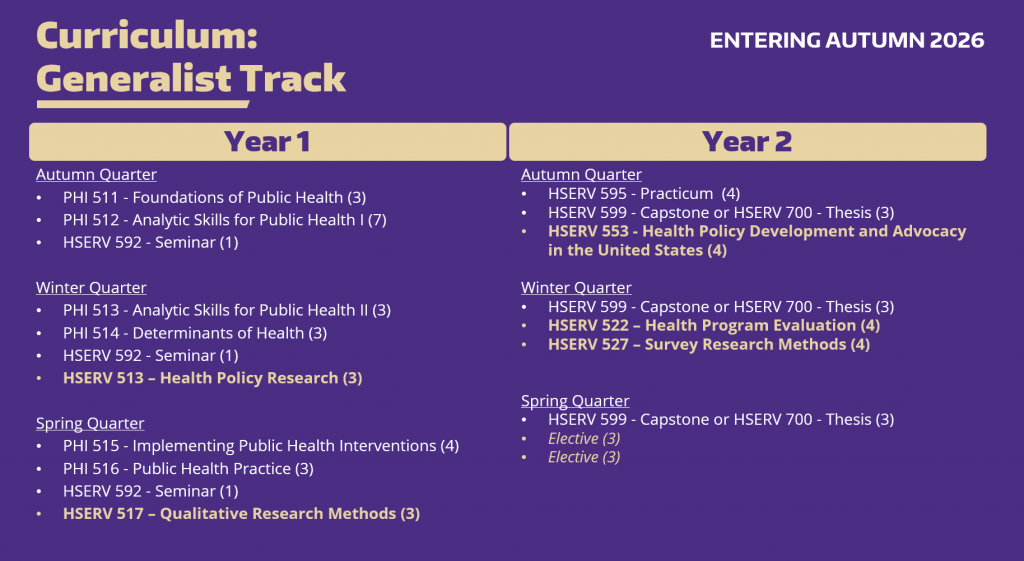
This concentration is especially well suited for students with career goals that span across policy, systems, and social and behavioral dimensions of public health. By sharing a mix of required coursework with our other two concentrations, the Generalist concentration grounds students in complementary approaches to public health—with broad training in both practice and research.
Generalist Concentration Required Courses
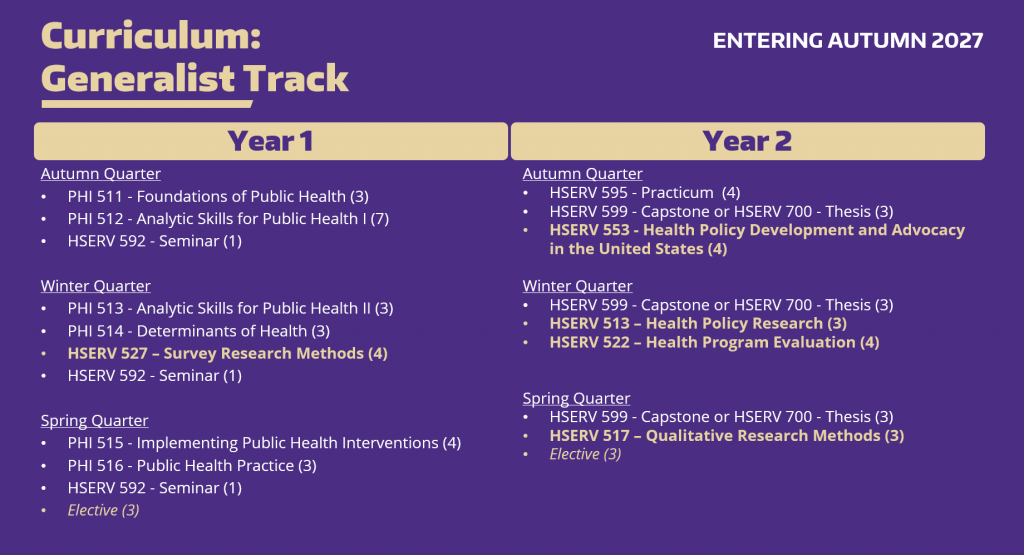
- HSERV 513: Health Policy Research – Extends students’ understanding of the nature of health policy and health policy development in the context of a market-based economy.
3 credits
Also required by HSP - HSERV 517: Qualitative Research Methods – Builds on introductory training in qualitative research methods by diving deeper into different frameworks, study designs, sampling approaches, and data collections tools. Covers various data analytic approaches, as well as data visualization, interpretation, writing and presenting qualitative research findings. Students learn to apply these concepts and execute a qualitative research project from start to finish.
3 credits
Also required by SBS - HSERV 522: Health Program Evaluation – Focuses on the use of evaluations within health programs. Discusses how program evaluations utilize research methods to answer questions concerning efficacy, implementation, and drivers of changes in health. It also looks at the reasons for creating program evaluations — the drivers of evaluation, how results can be transformed into action, and the role of equity in formulating and implementing evaluation results.
4 credits
Required by all three concentrations - HSERV 553: Health Policy Development and Advocacy in the United States – Practice-oriented course designed to enhance knowledge and cultivate skills for U.S. health policy development. Students learn effective policy analysis, research, and communications skills.
3 credits
Also required by HSP - HSERV 527: Survey Research Methods – Provides students with skills in questionnaire development and survey methods. Students develop a questionnaire and design a survey research proposal on a health-related or social topic.
4 credits
Also required by SBS
Health Systems and Policy Concentration

Health Systems and Policy
Faculty Lead: Molly Firth (she/her), MPH
The Health Systems and Policy (HSP) concentration is for students who seek a career of leadership in public or private efforts to improve the performance of the health system.
Students who complete the concentration will be well grounded in core competency areas of public policy development, health economics, law, and ethics.
In addition, HSP students will have a solid foundation in key analytic disciplines including biostatistics, epidemiology and qualitative methods. They can also acquire a deep understanding of how and where public policy is developed, what forms it takes, the relevant actors and institutions, and the economic and legal forces that affect and are affected by public policy.
Most HSP students choose a capstone project as their culminating project, though they also have the option to choose a thesis project.
HSP Concentration Required Courses
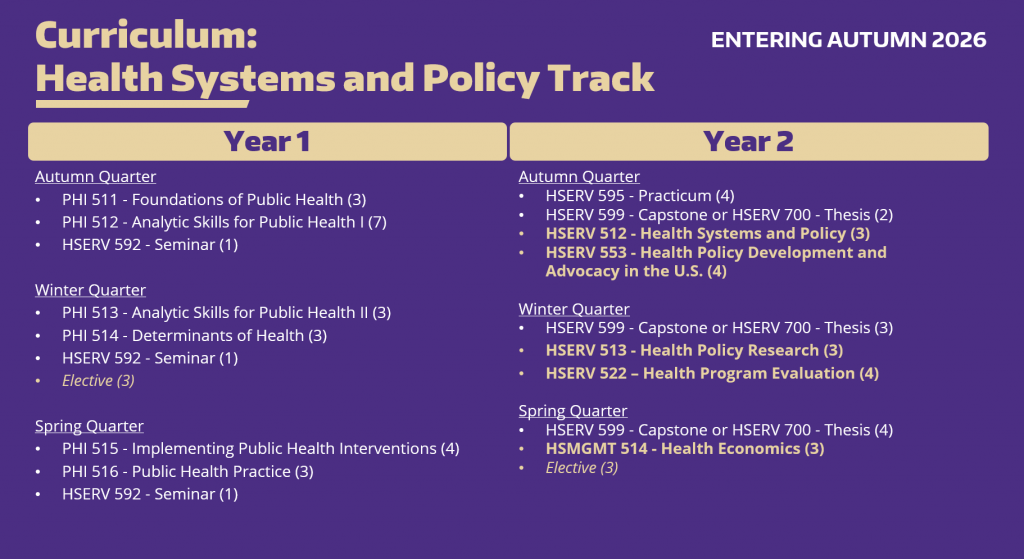
- HSERV 512: Health Systems and Policy – Students review and examine selected topics from literature. Includes need and access to care; theory and effects of health insurance; private and public insurance programs; managed care; costs/expenditures; availability and organization of health resources; and quality assessment and improvement.
3 credits - HSERV 513: Health Policy Research – Extends students’ understanding of the nature of health policy and health policy development in the context of a market-based economy.
3 credits
Also required by Gen - HSMGMT 514: Health Economics – Uses economic concepts and tools to examine range of issues pertaining to healthcare, delivery of healthcare services. Includes demand analysis, production of health services, expenditure growth, markets for hospital and physician services, externalities. Emphasis on using economics to examine issues and solve problems. Prior economics courses not required.
4 credits - HSERV 522: Health Program Evaluation – Focuses on the use of evaluations within health programs. Discusses how program evaluations utilize research methods to answer questions concerning efficacy, implementation, and drivers of changes in health. It also looks at the reasons for creating program evaluations — the drivers of evaluation, how results can be transformed into action, and the role of equity in formulating and implementing evaluation results.
4 credits
Required by all three concentrations - HSERV 553: Health Policy Development and Advocacy in the United States – Practice-oriented course designed to enhance knowledge and cultivate skills for U.S. health policy development. Students learn effective policy analysis, research, and communications skills.
3 credits
Also required by Gen
Social and Behavioral Sciences Concentration

Social and Behavioral Sciences
Faculty Lead: Miruna Buta (she/her), PHD, MA
The Social and Behavioral Sciences (SBS) concentration is for students who wish to apply social and behavioral sciences theory and methods to the study, practice, and thought of public health. Survey research, statistics, behavioral measurement, ethnography, quality-of-life assessment, community-based participatory research, and cost-effectiveness analysis are highlighted.
The focus of the concentration is on research and application of knowledge concerning the relationships among:
- Social, cultural, and behavioral processes
- Health and illness
- What society does and can do to promote health and prevent illness
Graduates who complete the concentration will have the background and skills to pursue careers in research or public health practice.
SBS Concentration Required Courses
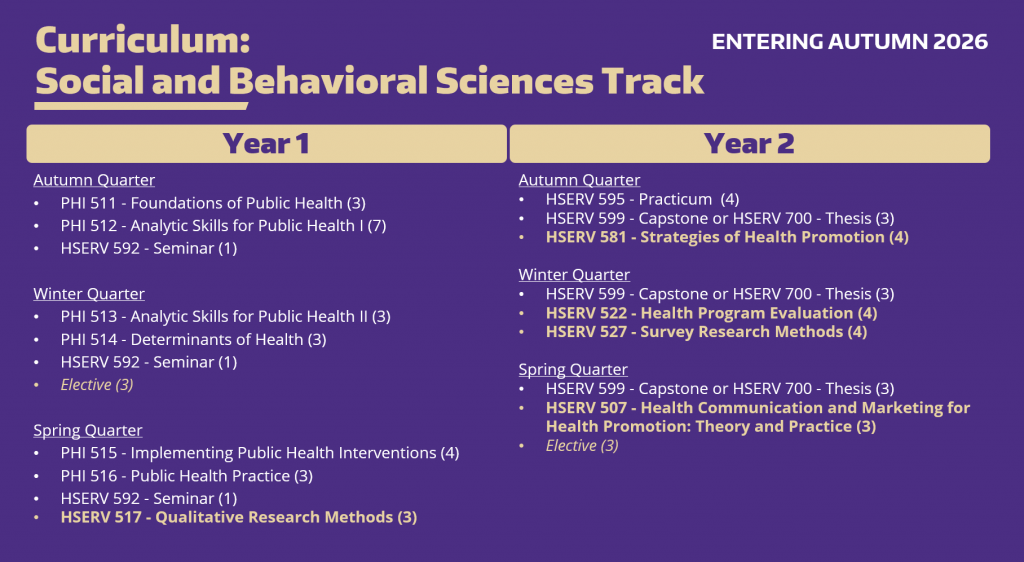
- HSERV 507: Health Communication and Marketing for Health Promotion: Theory and Practice – Provides an introduction to the field of health communication and social marketing. Focuses on how persuasive communication and marketing are most effectively used to improve population health and reduce inequities. Students develop and present a health communication campaign proposal.
3 credits - HSERV 517: Qualitative Research Methods – Builds on introductory training in qualitative research methods by diving deeper into different frameworks, study designs, sampling approaches, and data collections tools. Covers various data analytic approaches, as well as data visualization, interpretation, writing and presenting qualitative research findings. Students learn to apply these concepts and execute a qualitative research project from start to finish.
3 credits
Also required by Gen - HSERV 522: Health Program Evaluation – Focuses on the use of evaluations within health programs. Discusses how program evaluations utilize research methods to answer questions concerning efficacy, implementation, and drivers of changes in health. It also looks at the reasons for creating program evaluations — the drivers of evaluation, how results can be transformed into action, and the role of equity in formulating and implementing evaluation results.
4 credits
Required by all three concentrations - HSERV 527: Survey Research Methods – Provides students with skills in questionnaire development and survey methods. Students develop a questionnaire and design a survey research proposal on a health-related or social topic.
4 credits
Also required by Gen - HSERV 581: Strategies of Health Promotion – Assessment of health promotion planning, implementation, and evaluation strategies for their strengths, weaknesses, and effectiveness. Students critique strategies to modify behavioral factors that influence lifestyles of individuals, including decisions influencing their reciprocal relationship with environmental factors affecting the health of individuals, organizations, and communities.
4 credits
Substitutions or waivers of the concentration requirements are rare and can only be made with the approval of the concentration faculty lead.
Electives and Methods
Students in all three concentrations complete at least 7 elective credits (~2 courses).
The following may not be exhaustive lists of elective and methods courses. Review the HSERV course catalog (levels 500+) to find all available elective/methods credits within the HSPop department.
HSERV Elective Courses
HSERV 507: Health Communication and Marketing for Health Promotion: Theory and Practice
Provides an introduction to the field of health communication and social marketing. Focuses on how persuasive communication and marketing are most effectively used to improve population health and reduce inequities. Students develop and present a health communication campaign proposal.
3 credits
SBS Required Course
HSERV 509: Public Health Informatics
Introduction to the emerging field of public health informatics. Covers general public health topics as well as key public health informatics issues and applications. Evaluates a public health information system.
3 credits
HSERV 511: Introduction to Health Services and Public Health
History, organization, and effectiveness of U.S. healthcare and public health systems. Determinants of health, need, and utilization. Public and private financing. Supply and provision of personal and public health services. Managed care. Government and private sector roles.
3-4 credits
HSERV 512: Health Systems and Policy
Students review and examine selected topics from literature. Includes need and access to care; theory and effects of health insurance; private and public insurance programs; managed care; costs/expenditures; availability and organization of health resources; and quality assessment and improvement.
3 credits
HSP Required Course
HSERV 514: Social Determinants of Population Health and Health Disparities
Explores the elements and actions of a population health approach, including conceptualizing the determinants of health, synthesizing knowledge about major social determinants, and applying knowledge to improve population health and reduce health disparities.
3 credits
HSERV 515: War and Health
Explores the health consequences of war (injury, infectious diseases, mental health, chronic disease, malnutrition, infrastructure) and the role of health professionals and others in preventing war (advocacy, measurement and application of epidemiology methods, promotion of social equity).
5 credits
HSERV 542: Epidemiology of Maternal and Child Health Problems
Contributions to understanding and prevention of major maternal and child health problems, including pregnancy outcome, infant and child morbidity and mortality, maternal morbidity and mortality, abnormal child growth and development, and early-life factors in adult health problems.
3-4 credits
HSERV 544: Maternal & Child Health in Developing Countries
Emphasizes critical health problems of women and children in developing countries in social, economic, and cultural contexts. Practical approaches to developing MCH programs shared via lecture/discussions, exercises, and small group work. Students acquire skills in baseline assessment, setting objectives, planning and evaluating interventions, and involving communities.
3 credits
HSERV 551: Public Health Law
Focuses on the role of law in public health administration and in the increasingly regulated healthcare industry. Provides a foundation in the relevant law for public health officers and healthcare industry administrators.
2 credits
HSERV 553: Health Policy Development and Advocacy in the United States
Practice-oriented course designed to enhance knowledge and cultivate skills for U.S. health policy development. Students learn effective policy analysis, research, and communications skills.
4 credits
Gen and HSP Required Course
HSERV 554: Homelessness: Destitute Poverty in the Emerald City
Covers the landscape and types of homelessness in Seattle and beyond. Topics include: causes and health consequences of homelessness, the role of destitute poverty in the loss of housing stability, history and politics of homelessness in Seattle, the effects of COVID-19 on homeless policy, hearing the voices of the unhoused, activism, shaming and saviorism, and solutions, big and small.
1-3 credits (max. 3)
HSERV 555: Health Disparities
Focuses on health disparities and health inequity in the United States. Course will cover both theoretical and empirical approaches to understanding patterns of health across social groups, with a focus on designing research and public health programs to addressing health disparities.
2 credits
HSERV 573: Topics in Indigenous Health
Covers the fundamentals of Indigenous health, including Indigenous conceptual frameworks specific to health, wellness, and resilience. Topics include Indigenous social determinants of health, Federal Indian health policy, and American Indian and Alaska Native trends in population health outcomes within the context of the socio-ecological model.
2-3 credits
HSERV 579: Structural Racism and Public Health
Introduces the concept of institutional racism and ways structural racism undermines public health. Discusses history of racism and intersections between structural racism and other systems of oppression. Explores relationship to racism and ways internalized racism acts as a barrier to health equity. Considers public health practitioners’ role in addressing racism.
1 credit
HSERV 581: Strategies of Health Promotion
Assessment of health promotion planning, implementation, and evaluation strategies for their strengths, weaknesses, and effectiveness. Students critique strategies to modify behavioral factors that influence lifestyles of individuals, including decisions influencing their reciprocal relationship with environmental factors affecting the health of individuals, organizations, and communities.
4 credits
SBS Required Course
HSERV 587: Health Policy Economics
Applies economic theory to selected topics in healthcare, including information, risk and insurance, industry organization, government regulation, and public health issues. Emphasizes policy implications of these applications.
3 credits
HSMGMT 514: Health Economics
Uses economic concepts and tools to examine range of issues pertaining to healthcare, delivery of healthcare services. Includes demand analysis, production of health services, expenditure growth, markets for hospital and physician services, externalities. Emphasis on using economics to examine issues and solve problems.
3 credits
HSP Required Course
HSERV Methods Courses
HSERV 513: Health Policy Research
Extends students’ understanding of the nature of health policy and health policy development in the context of a market-based economy.
3 credits
Gen and HSP Required Course
HSERV 517: Qualitative Research Methods for Health Systems and Population Health
Builds on introductory training in qualitative research methods by diving deeper into different frameworks, study designs, sampling approaches, and data collections tools. Covers various data analytic approaches, as well as data visualization, interpretation, writing and presenting qualitative research findings. Students learn to apply these concepts and execute a qualitative research project from start to finish.
3 credits
Gen and SBS Required Course
HSERV 522: Health Program Evaluation
Focuses on the use of evaluations within health programs. Discusses how program evaluations utilize research methods to answer questions concerning efficacy, implementation, and drivers of changes in health. It also looks at the reasons for creating program evaluations — the drivers of evaluation, how results can be transformed into action, and the role of equity in formulating and implementing evaluation results.
4 credits
Gen, HSP, and SBS Required Course
HSERV 523: Advanced Health Services Research Methods I – Large Public Databases; Big Data
Introduces the new big data of health services research, health claims, and survey databases. Discusses the promises and pitfalls of the data and models for analyzing the correlates of health care costs and utilization.
4-5 credits
HSERV 524: Advanced Health Services Research Methods II – Hierarchical and Incomplete Data
Introduces advanced biostatistical techniques for analyzing incomplete data in population health research. Examines a wide range of topics including: missing data and potential outcome framework for causal inference, propensity score and multiple imputation, multilevel random effect linear and logistic models, and empirical Bayes prediction.
4-5 credits
HSERV 525: Advanced Health Services Research Methods III – Casual Inference Using Observational Data
Focuses on reviewing statistical methods developed for “micro” (individual-level) data on behavior (choices or exposures) and outcomes in order to make causal inference about the role of a choice or an exposure on outcomes.
4-5 credits
HSERV 527: Survey Research Methods
Provides students with skills in questionnaire development and survey methods. Students develop a questionnaire and design a survey research proposal on a health-related or social topic.
4 credits
Gen and SBS Required Course
HSERV 548: Research Methods of Social and Contextual Determinants of Health
Explores study-design, measurement, analytic, and interpretation issues applicable to research on social and contextual determinants of health and health disparities. This lecture/seminar course is offered to graduate students with knowledge of epidemiologic and biostatistical principles who are interested in understanding complex relationships between social/contextual factors and health.
3 credits
HSERV 584: Assessing Outcomes in Health and Medicine
Concepts and methods for developing and using patient-reported outcomes in health and medicine. Emphasis on patient self-reported health status and quality of life. Qualitative research and psychometric methods applied to health outcomes assessment and all applications.
3 credits
HSERV 589: Community Based Participatory Research and Health
Begins with a research topic of importance to the community with the aim of combining knowledge and action for social change. Provides an understanding of principles and strategies, and appreciate of its advantages and limitations, and skills for participating effectively.
3 credits
Students may also take elective courses outside of the department. The following course prefixes that are level 500 or above count toward your elective class requirement: HSERV, BIOST, ENV H, EPI, G H, HSMGT, NUTR, PHG, B H, SOC W, ANTH, CSDE, ECON, STAT, SOC, URBDP, UCONJ, CONJ, FAMED, PHARM, PUBPOL, PPM, PABIO, LAW H, SOC WL, and NURS.
Schedules
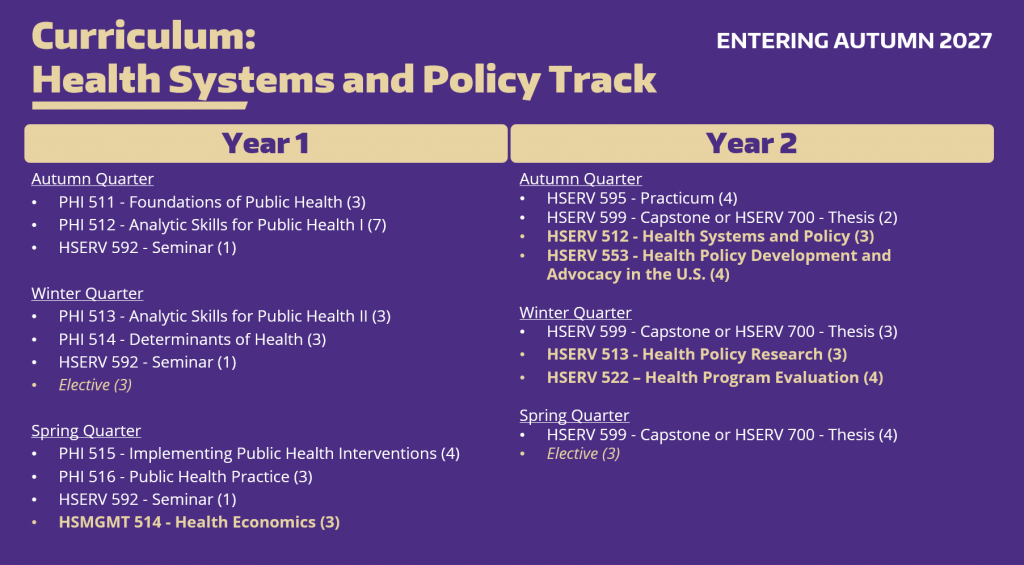
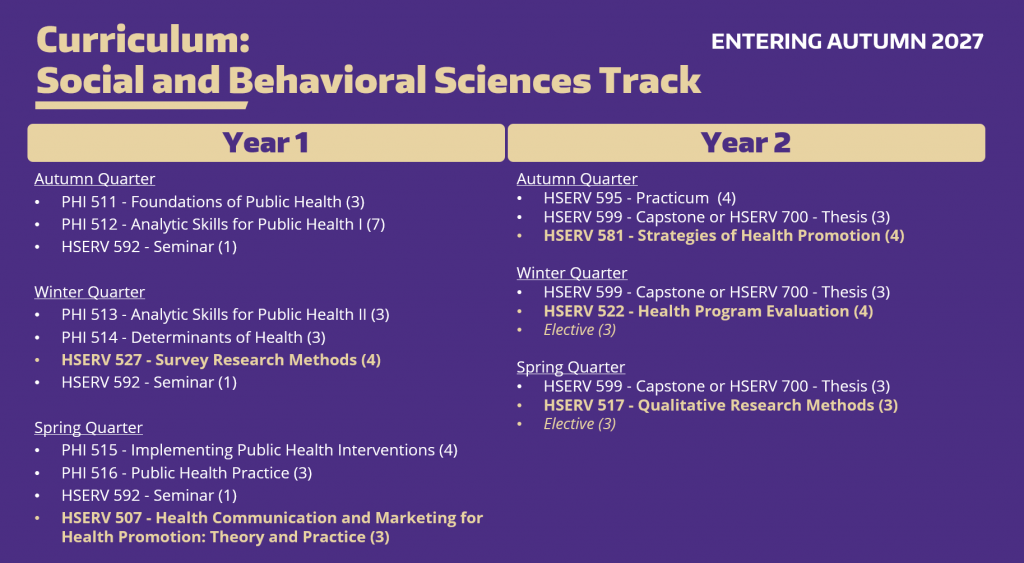
Starting in 2026, all student cohorts entering in even numbered years will have the Autumn 2026 schedule, and all cohorts entering in odd numbered years will have the Autumn 2027 schedule. Students are welcome to take additional electives wherever their schedules allow.
Swipe through the time schedules for all three concentrations based on entry year: